
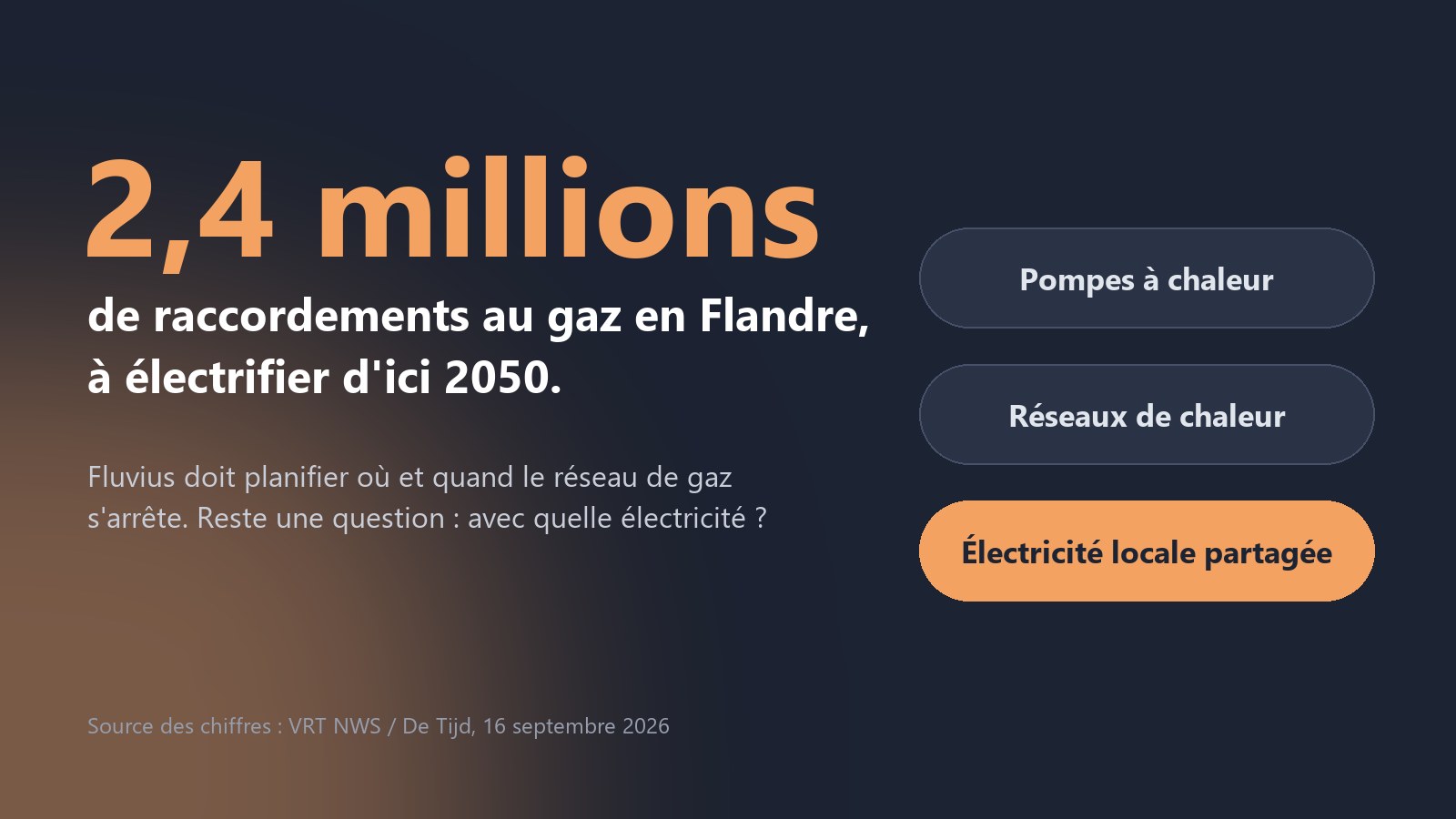
The news made little noise outside Flanders, yet it is major. According to VRT NWS, quoting De Tijd, the Flemish government has tasked Fluvius, the gas grid operator, with preparing the gradual phase-out of the natural gas grid. The question is no longer whether Flanders will leave gas, but where and when the tap will close first.
What has been decided
- The horizon is 2050. No explicit end date for gas was ever set, but Flanders aims for climate neutrality by 2050. Natural gas is a fossil fuel and has no place in that scenario.
- The scale is considerable. About two in three Flemish households still heat with gas, and Fluvius still counts 2.4 million connections. There are 24 years left.
- A draft decree was approved this summer. It entrusts Fluvius with planning the phase-out. The operator will systematically list the places where the gas grid can be shut down, starting with neighbourhoods that already have a heat network or where most customers heat with a heat pump.
- Gas connections are already banned for new builds and for demolition and reconstruction, residential and non-residential alike, with a few exceptions.
Fluvius itself acknowledges two consequences. First, the fewer users on the gas grid, the more its cost weighs on those who remain. Second, the last households in a street or neighbourhood could eventually be disconnected by obligation. There is no need to panic: the grid works normally and will remain reliable in the coming years. Flemish Energy Minister Melissa Depraetere promises a social approach, with alternatives so that everyone can keep up, and announces investments in stronger electricity grids, heat pumps and heat networks.
The real question: with what electricity?
Leaving gas means electrifying. A heat pump replaces a boiler, an electric car replaces a fuel tank, an industrial process moves from a burner to a resistor or a high-temperature heat pump. Every kWh of gas less is a fraction of a kWh of electricity more. Three effects follow, and they directly concern Flemish businesses, municipalities and co-ownerships.
- The price of electricity becomes the line that matters. When heating, mobility and part of the processes move onto the electricity meter, a few tens of euros per MWh make a five- or six-figure difference on the annual bill.
- The electricity grid comes under pressure. The minister says so herself by announcing reinforcements. The more consumption rises, the more valuable it becomes to consume electricity where it is produced, at the moment it is produced.
- Solar surplus gains value. Flanders is covered with photovoltaic roofs whose excess currently goes to the grid for a few cents. In an electrified world, that excess has a neighbour ready to take it.
Why the energy community is the natural complement to electrification
An energy community replaces neither the heat pump nor the heat network. It answers the next question: where does the electricity come from, and at what price. Within an energy sharing operation, local producers sell their surplus to neighbouring consumers, through the existing grid, quarter-hour by quarter-hour.
- A price fixed by contract, below the supplier's price. The consumer pays for shared electricity at a rate agreed for several years, lower than the current contract. It is a direct protection against volatility, precisely when electricity weighs more in the budget.
- No investment, no works. No panels to install, no meter to change, no change of supplier. The usual supplier automatically covers what the community does not.
- A better-valued surplus for producers. Solar excess is sold within the community at a price above the injection tariff, which shortens the payback of existing installations and makes the next ones easier to decide.
- Less pressure on the grid. Electricity produced in a business park and consumed in the same park does not climb the voltage levels. That is exactly what grid operators are looking for.
Let us be precise about the limits. Solar produces mostly from April to September, and a heat pump consumes mostly in winter. Sharing will therefore not cover all electrified heating. It does cover daytime uses very well: offices, shops, schools, workshops, cooling, vehicle charging, hot water production, pre-heating buildings during sunny hours. And it lowers the average price per kWh over the whole year. That is why we simulate every candidate on their real consumption profile: a good member is a consumer whose curve looks like the production curve. Electrification, by shifting uses towards daytime and adding flexibility, improves that profile.
In Flanders, the community already exists
SamenWatt is the Flemish energy community managed by RaYSun. It is an autonomous structure, with its articles of association and its members, which today hosts three sharing operations: Wanele, Facq Vlaanderen and FICO Energy, i.e. 45 members and 2,512 MWh shared per year. Nobody has anything to create: joining an operation means signing a contract. For a business park, a group of companies or a municipality that wants to connect its buildings, a dedicated operation can be set up within SamenWatt, and RaYSun then handles all of its management: study, procedures with Fluvius and the regulator, allocation keys, invoicing, general meetings.
What we advise Flemish organisations
- Do not wait for Fluvius's map to act on electricity. Planning the gas phase-out will take years. The price of your electric kWh is being decided now.
- Think sharing before sizing. A heat pump, a charging point or a new solar roof is not sized the same way when the surplus has a local outlet and daytime consumption is cheaper.
- If you already produce, let it be known. The surplus you inject today at a low price is precisely what consumers in the middle of electrification are looking for.
A simulation on your real profile takes a few minutes. You can also book a call with one of our experts, or read our guide to energy communities in Belgium.
Source
VRT NWS, "Waar in Vlaanderen gaat de gaskraan eerst dicht? Fluvius krijgt opdracht om afbouw aardgasnet voor te bereiden", 16 September 2026, based on De Tijd: read the article (in Dutch). SamenWatt figures: projects published on raysun.solar.