
The project
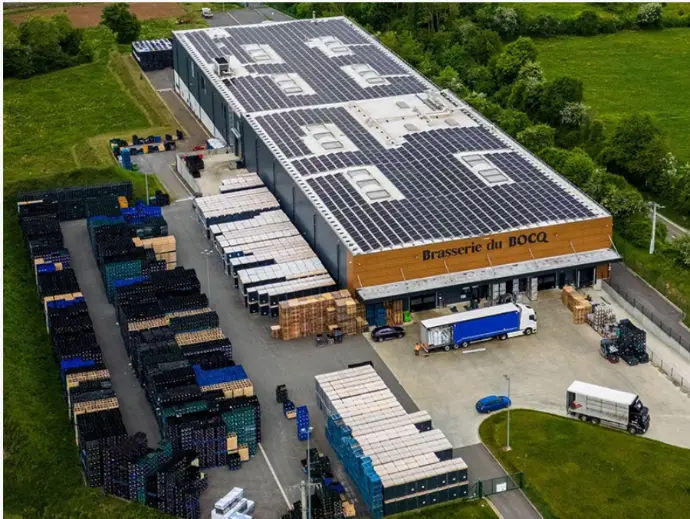
A family brewery rooted in the Bocq valley, Brasserie du Bocq operates several buildings in Purnode: the production site, its annexes — and the solar roofs that come with them. Rather than injecting its solar surplus into the grid at rock-bottom prices, the brewery chose to share it: between its own buildings first, then with some of its employees, at their homes.
The operation brings together 4 members and illustrates the "Multi-site" model: the production of one or more sites powers the group's other buildings and its trusted ecosystem. It is hosted within the energy community WalloWatt (ES2), with RaYSun handling operational management — procedures, contracts, allocation and billing.
A first in Wallonia: when sharing started in late May 2025, no other multi-site operation of this kind was in service in the region.
One year of sharing, in real figures
Unlike study projections, the figures below are measured by our My Community monitoring platform, on the operation's actual meters (May 2025 → May 2026):
shared in 12 months
consumed directly within the community
of injection put to use
of the solar surplus consumed locally rather than lost to the grid
of needs covered
out of 2,265 MWh of members' total consumption
membres
brewery buildings and employees
Of the 243,8 MWh injected by the brewery's solar installations, 167,3 MWh were consumed by the operation's members — over two thirds of the surplus turned into useful local electricity instead of being sold back to the grid at low prices. That is exactly what energy sharing promises: every kilowatt-hour produced finds a local consumer first.
From study to reality
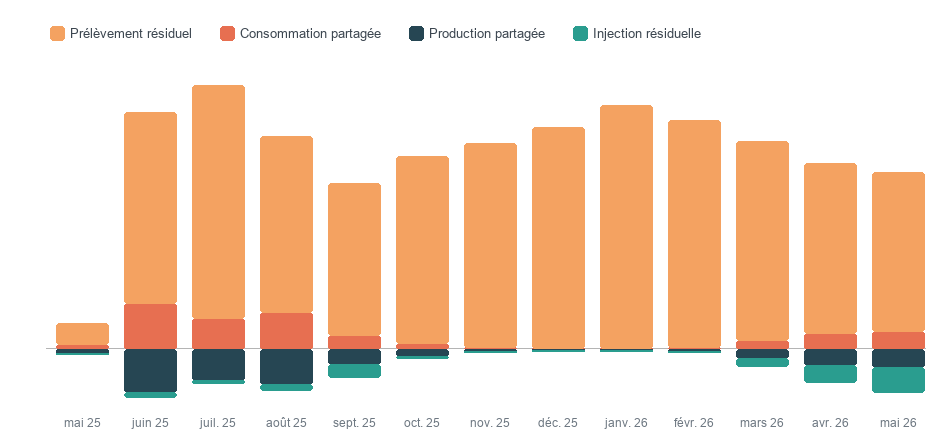
Our initial study, based on members' real consumption profiles, identified 195 MWh shareable per year. After twelve months of operation, the meter shows 167.3 MWh — an achievement rate of 86 % in the very first year, ramp-up included. The gap is largely explained by higher-than-expected direct self-consumption sur les sites producteurs : une part de l’énergie est consommée sur place avant même de transiter par le partage — ce qui reste tout bénéfice pour la brasserie. Les flux mensuels mesurés ci-dessous (en MWh) montrent la saisonnalité du partage : maximal du printemps à la fin de l’été quand le soleil produit, il laisse place l’hiver à la fourniture classique :
Key takeaways
- The Multi-site model also works for an SME: you don't need to be a large group to share between your buildings and employees.
- Hosting the operation in an existing community (WalloWatt) avoids creating a dedicated legal structure: sharing started within a few weeks.
- Continuous monitoring makes it possible to optimise allocation keys across the seasons — the summer/winter gap is visible in the monthly flows.
Does your organisation have several buildings, or a poorly valued solar surplus? Let's talk about your project — the assessment is free.