
Introduction
In an energy sharing operation, the electricity injected by producers is allocated to consumers quarter hour by quarter hour. The rule that sets this allocation is called the allocation key. It determines what each participant receives and, overall, how much energy the operation manages to share. The three Belgian Regions apply the same basic principles, but each has defined its own keys, its own number of calculation rounds and its own procedure for changing a key. This article first describes what is common, then the details for Wallonia, Flanders and Brussels. Pick your Region in the table of contents to go straight to the relevant part.
The rules common to the three Regions
- A virtual calculation, per quarter hour. Nothing changes physically on the grid. The distribution system operator (DSO) reads the participants' smart meters and calculates, for each quarter hour, the shared volume allocated to each of them.
- A cap. A participant never receives more than it takes from the grid during the quarter hour. Whatever the key allocates beyond its needs becomes an excess.
- One key for the whole injection. When an operation has several producers, their injections are added together and the key applies to the total. The standard keys do not provide a separate key per producer.
- The surplus goes back to the producers. Electricity that found no consumer is reallocated to the producers, pro rata to their injection. They can sell it through their usual injection contract.
- One operation at a time. The offtake of an access point, like its injection, belongs to a single sharing operation.
- A key declared to the grid operator. The participants agree on the key. The manager or the representative of the operation declares it to the grid operator and requests any changes.
Fixed key or dynamic key
All keys fall into two families.
- The fixed key. The percentages are known in advance and do not change from one quarter hour to the next: equal shares, or percentages agreed between the participants, for example according to each one's investment or the shares in a co-owned building. It is simple and predictable. Its limit: it sometimes allocates more to a participant than it consumes, and that excess is not shared.
- The dynamic key. The rule is known in advance, but the percentages are recalculated every quarter hour. The most common one is the pro rata key: each participant receives a share equal to its consumption divided by the total consumption of the participants.
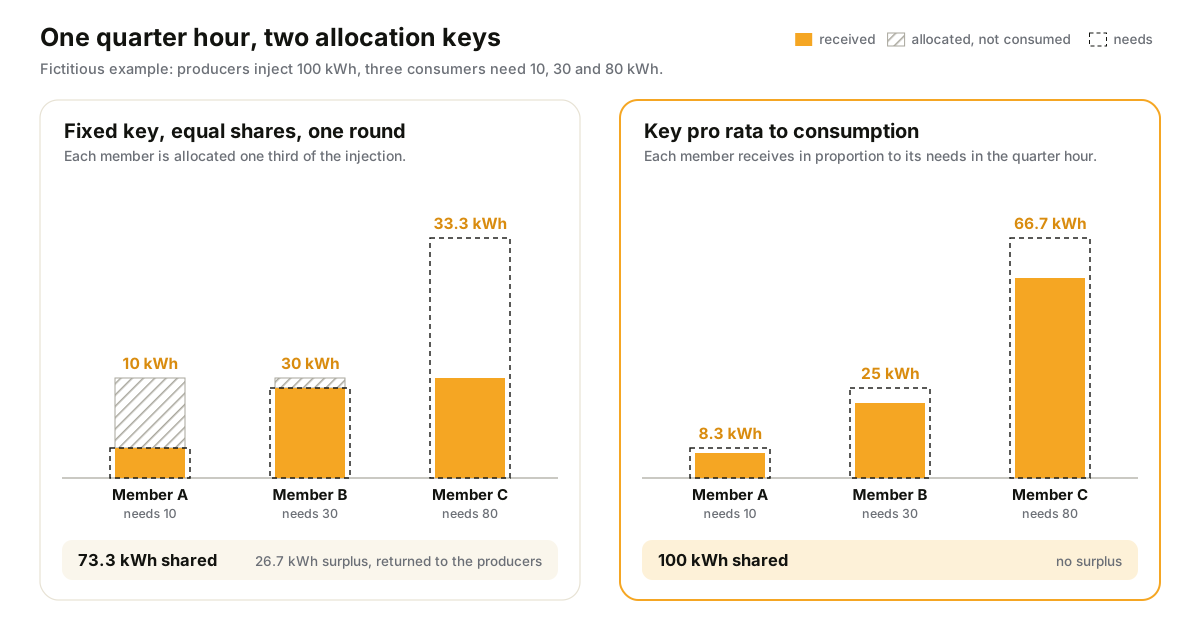
Between the two, the Regions allow the calculation to be repeated: an additional round redistributes the excess of the previous round to the participants that are not yet covered. This point, the number of rounds and the key used in each of them, is where the three Regions differ most.
In Wallonia
Framework. The rules are set at regional level by the electricity decree, the Walloon Government order of 17 March 2023 and the list of standard keys drawn up by CWaPE, the Walloon regulator. They apply to all grid operators: ORES, RESA, AIEG, AIESH and REW. WalloWatt is one of the energy communities managed by RaYSun. It is the main one in Wallonia: it hosts the largest number of sharing operations.
Three standard keys.
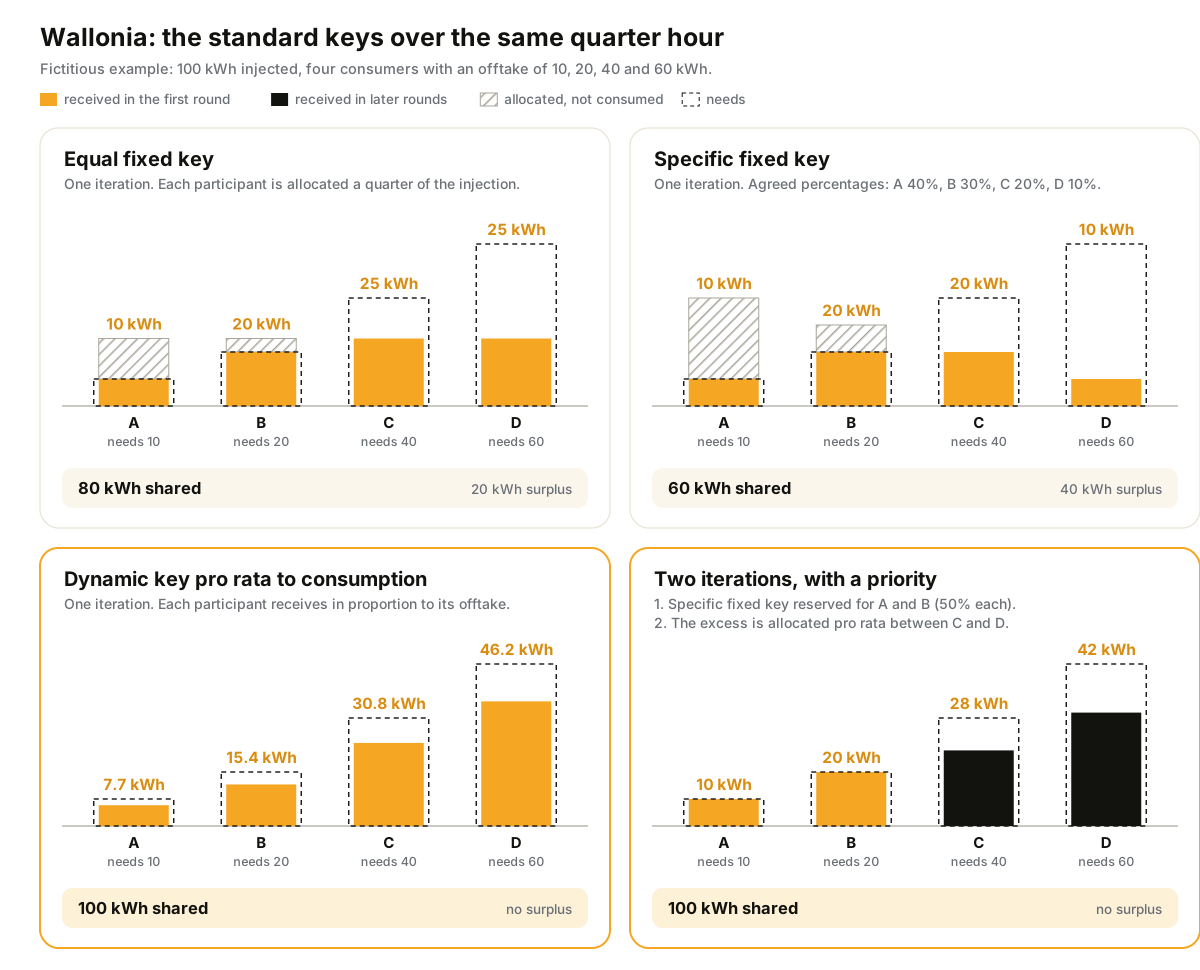
- Equal fixed key. All participants receive the same share. The grid operator works it out itself from the number of participants.
- Specific fixed key. The percentages are set by an agreement between the participants: share of the investment, shares in a co-owned building, consumption profiles.
- Dynamic key pro rata to consumption. Each participant's share equals its offtake divided by the sum of the offtakes of all participants, for every quarter hour.
Up to three iterations. The calculation can be repeated at most three times per quarter hour. The second iteration allocates the excess of the first to the participants whose offtake is not fully covered, and the third does the same with the excess of the second. Each iteration has its own key. Two rules frame this choice.
- A priority is possible. The first iteration can provide for a priority allocation, or even an exclusive one, in favour of certain participants. The example given by CWaPE is that of public buildings served first, with the balance then going to the other participants.
- A specific fixed key does not change during the calculation. If it is used in several iterations, its percentages stay the same from one to the next.
Example. In one quarter hour, 100 kWh are injected and four participants take 10, 20, 40 and 60 kWh. In a single iteration, the equal key shares 80 kWh, a specific key that is poorly matched to consumption shares 60 kWh, and the pro rata key shares everything. The last calculation combines two iterations: A and B are served first and covered at 100%, then the excess is allocated pro rata between C and D.
Non-standard key. A standard key is accepted by the grid operator. Another key can be proposed: the grid operator then examines its technical and economic feasibility, states the time needed to implement it and proposes an alternative key.
Declaration and changes. The key is declared in the sharing form, which states the number of iterations and the key used in each. To change it, the representative of the operation submits a modification form to the grid operator, which sends back an amendment to the agreement. For a simple change of standard key, the procedure provides up to 20 working days for sending the amendment, 10 working days for returning it signed, and entry into force on the 20th working day after it is received, which makes 50 working days at most. This change does not require a new authorisation from CWaPE. The authorisation must however be reviewed when participants are added, or when a production installation is added or removed; the maximum time then rises to 110 working days.
In Flanders
Framework. The rules are set out in the energy sharing protocol of Fluvius, the Flemish grid operator. The current version, 3.2, was approved in July 2024 by the Flemish regulator, the Vlaamse Nutsregulator (formerly VREG). SamenWatt is one of the energy communities managed by RaYSun. It is the main one in Flanders: it hosts the largest number of sharing operations.
Percentages per offtake point. The manager of the operation enters, for each offtake point, a percentage with at most two decimals. The total must be 100%. No percentage is assigned to injection points. The manager then chooses, for the whole group, one of the three types of key.
A rule specific to Flanders. A participant never receives its own injection. Yet a participant that both produces and consumes also has a percentage in the key. The difference between the first two keys lies in what happens to that percentage when its own injection is being allocated.
- Fixed key (vaste verdeelsleutel). The percentages are applied as they are, in a single calculation. A participant's share of its own injection is not distributed: it is returned to that participant as surplus. Whatever a participant is allocated beyond its consumption also goes back to the producers, with no redistribution between consumers.
- Relative key (relatieve verdeelsleutel). The calculation is also done in one go, but a participant's injection is offered in full to the others. For that injection, the percentages of the other participants are scaled up to 100%, keeping the same proportions between them. Whatever exceeds a participant's consumption still goes back to the producers.
- Optimal key (optimale verdeelsleutel). The first iteration is identical to the relative key. The share of the participants that are already covered is then redistributed to the others, pro rata to their percentages, as many times as needed, until there is no injection left to allocate or no offtake left to cover. This is the key that aims for the maximum allocation of the available energy.
Example. In one quarter hour, A injects 80 kWh and B 20 kWh. B also consumes 30 kWh, C 20 kWh and D 60 kWh. The key gives 40% to B, 30% to C and 30% to D.
- With the fixed key, B's 20 kWh are allocated at 30% for C and 30% for D, that is 6 kWh each. The remaining 40%, 8 kWh, is B's share of its own injection: it is not shared. In total, 80 kWh are shared.
- With the relative key, the percentages of C and D, 30% each, are scaled up to 50% each for B's injection. C and D are allocated 10 kWh each instead of 6, and the 8 kWh are put back into play. In total, 84 kWh are shared. A surplus remains, because B and C are allocated more than they consume.
- With the optimal key, that surplus is redistributed to D, the only participant not yet covered. All 100 kWh are shared.
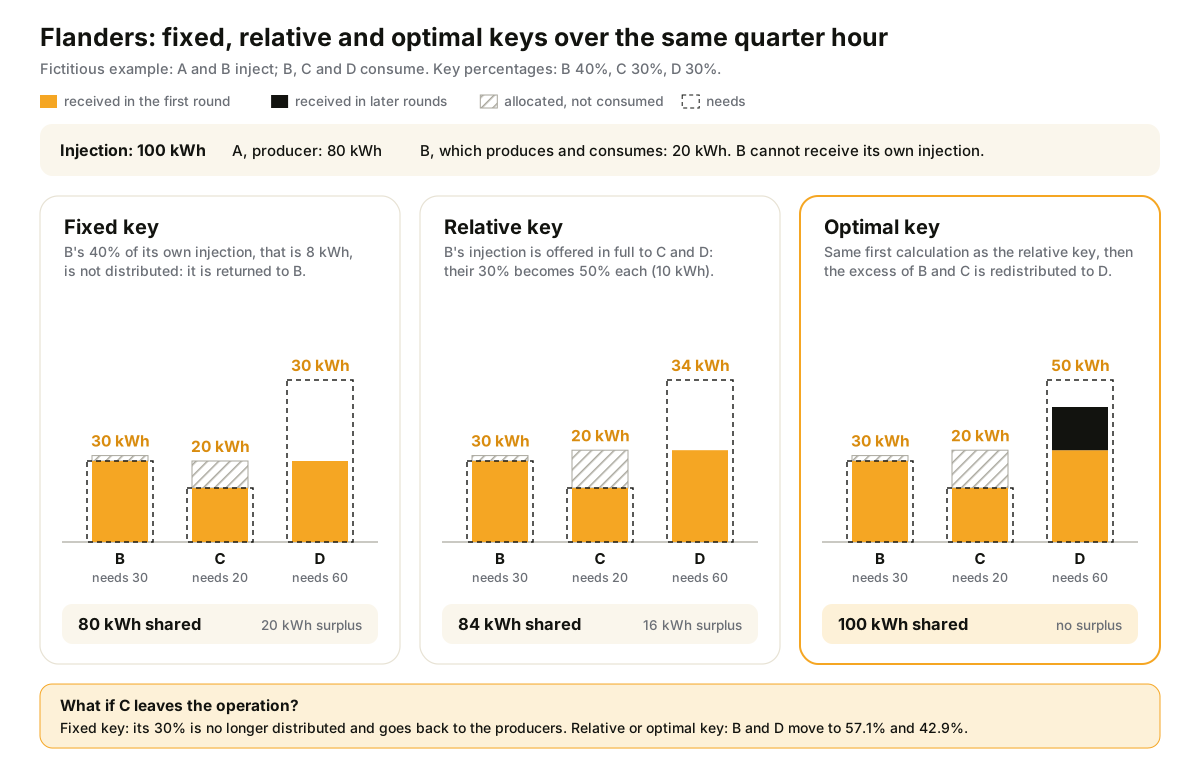
When a consumer leaves the operation. The same logic applies when Fluvius removes a consumer from the operation, for example after a move or when its mandate is withdrawn. Its percentage is set to zero. With a fixed key, the corresponding part of the injection is no longer distributed and goes back to the producers. With a relative or optimal key, the percentages of the remaining participants are applied proportionally: in the example, if C leaves, B's 40% and D's 30% become 57.1% and 42.9%. In every case, the manager of the operation is notified and can adjust the key.
No custom key, no priority. The choice is limited to these three types, and the protocol provides no order of priority between participants. The percentages themselves remain free.
Declaration and changes. The key is entered in the Mijn Fluvius portal by the manager mandated by the participants. The manager can change both the percentages and the type of key every day; the change takes effect at midnight. A new participant keeps a share of 0% until the key has been adjusted. Fluvius calculates the shared volumes every month; the results are generally available around the 25th of the following month.
In Brussels
Framework. The rules are set out in the Technical Regulation for the electricity distribution grid, approved by the Brussels regulator, Brugel, and in the explanatory note on allocation methods published by Sibelga, the grid operator. CityWatt is one of the energy communities managed by RaYSun. It is the main one in Brussels: it hosts the largest number of sharing operations, including Energilia Brussels.
Three methods, one of which has two variants. In Brussels, the term used is allocation method rather than key.
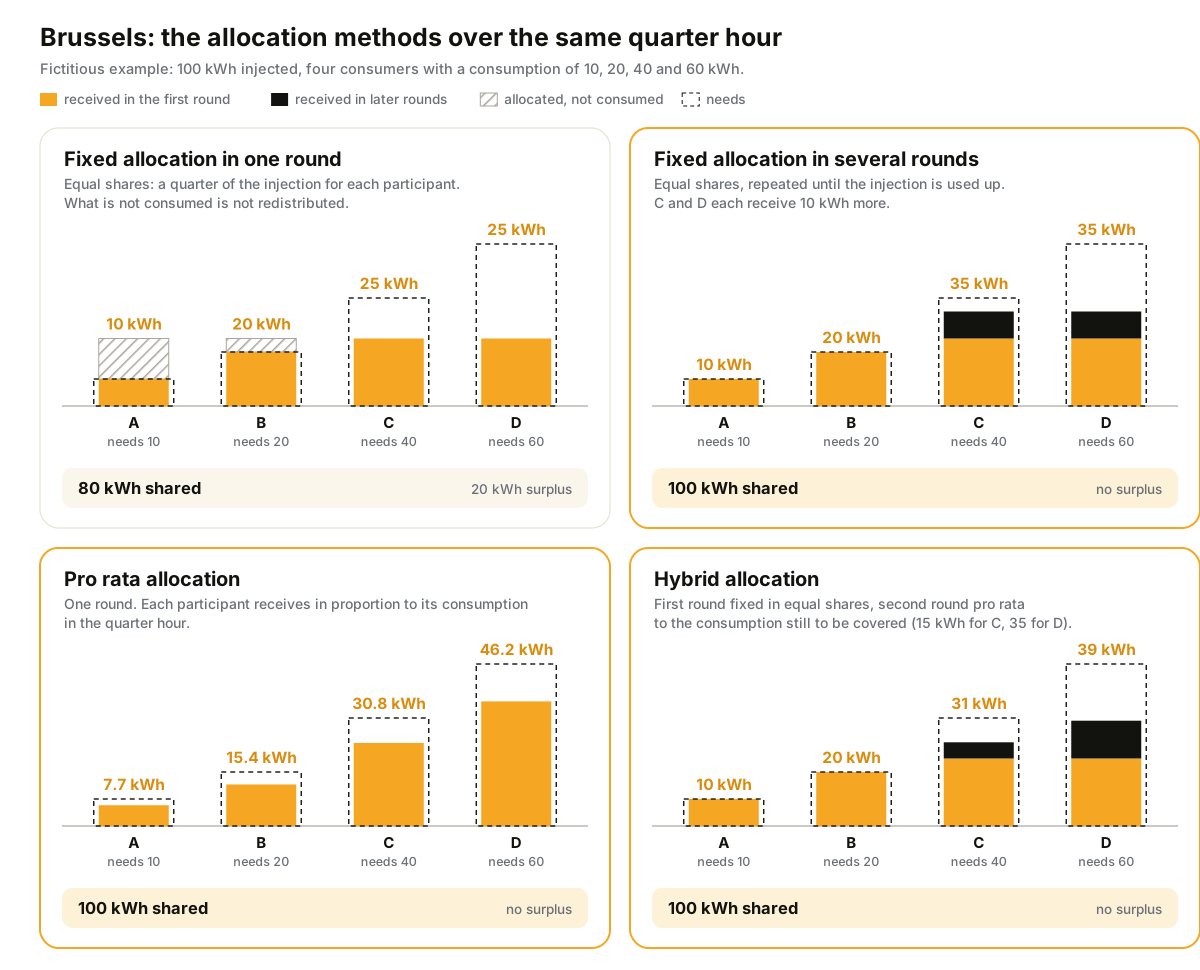
- Fixed allocation in one round. Each participant receives a constant percentage of the injection, equal for all or agreed between them, for example according to investments or shares in a co-owned building. Whatever a participant does not consume is not redistributed.
- Fixed allocation in several rounds. The allocation is repeated until there is no injection left to allocate or no consumption left to cover. According to Sibelga's explanatory note, this variant is only available with equal shares.
- Allocation pro rata to quarter-hour consumption. Each participant's share is proportional to its consumption relative to the total consumption of the participants. A single round is enough.
- Hybrid allocation. A first fixed round is followed by a second round pro rata to the consumption still to be covered. A parameter between 0 and 1 sets the part of the injection put into play in the first round; the second round allocates the rest, plus the surplus of the first.
Example. In one quarter hour, 100 kWh are injected and four participants consume 10, 20, 40 and 60 kWh. With equal shares in one round, 80 kWh are shared. The three other methods share all 100 kWh, but not in the same way: the allocation in several rounds gives as much to C as to D, the pro rata allocation follows each one's consumption, and the hybrid allocation, here with the whole injection put into play in the first round, lies in between.
One priority category. Whatever the method, one category of participants can be served first, for example the meters of the common areas of a building. The rest of the injection is then allocated to the other participants according to the chosen method. Only one priority category is possible at present.
Other methods. The Technical Regulation allows Sibelga to set new allocation methods, depending on their feasibility, on its own initiative or following a request.
Declaration and changes. The method is stated in the sharing form, submitted at least five working days before the desired start date. If it is complete, Sibelga validates it within five working days, and sharing starts on the first day of a month. The method can then be adjusted at any time: the adjustment takes effect on the first day of the following month.
Change under way. From 11 December 2025 to 31 January 2026, Sibelga held a public consultation on several proposals to change these methods. On the publication date of this article, the methods resulting from that consultation had not yet been published: the rules described above are those of the documents in force.
Comparison of the three Regions
| Wallonia | Flanders | Brussels | |
|---|---|---|---|
| Standard keys | Equal fixed, specific fixed, dynamic pro rata | Fixed, relative, optimal | Fixed in one or several rounds, pro rata, hybrid |
| Calculation rounds per quarter hour | Three iterations at most, one key per iteration | A single calculation (fixed, relative); iterations until nothing is left (optimal) | One round (fixed, pro rata), two rounds (hybrid), until nothing is left (fixed in several rounds) |
| Priority | First iteration with priority, or even exclusive | No order of priority provided | One priority category, served first |
| Other key | Possible, after a feasibility review by the grid operator | No, three types only | New methods set by Sibelga, depending on their feasibility |
| Changes | Form and amendment, up to 50 working days | Every day in Mijn Fluvius, effective at midnight | At any time, effective on the first day of the following month |
| Reference text | CWaPE list of standard keys, order of 17 March 2023 | Fluvius energy sharing protocol, version 3.2 | Technical Regulation, articles 4.61 to 4.71, and Sibelga note |
How to choose a key
The choice depends on the goal the participants set themselves.
- Share as much energy as possible. The keys that follow the actual consumption of each quarter hour do this best: the pro rata key in Wallonia, the optimal key in Flanders, the pro rata or hybrid allocation in Brussels.
- Reflect an investment or an agreement. A fixed key with agreed percentages allocates the energy according to each one's share. An additional calculation round then makes it possible to redistribute what was not consumed.
- Serve certain participants first. The priority first iteration in Wallonia and the priority category in Brussels make this possible.
- Plan for changes. The time needed to change a key ranges from one day in Flanders to several weeks in Wallonia. A key that recalculates itself, equal or pro rata, avoids having to redefine percentages every time a participant joins or leaves.
This choice is prepared on the participants' actual consumption and production curves. That is the role of the manager of the operation: RaYSun designs sharing operations on the basis of these profiles, declares the key to the grid operator and keeps it up to date.
Sources
- CWaPE, Liste de clés de répartition standards permettant la répartition des volumes partagés, proposal CD-23d27-CWaPE-0928 of 27 April 2023 (PDF, in French).
- CWaPE and grid operators, explanatory guide to the electricity sharing form in Wallonia and explanatory guide to the modification form, July 2025 (PDF, in French).
- CWaPE, Comment l'électricité partagée est-elle répartie entre les participants ? (in French).
- CWaPE, evaluation report on the framework for energy communities, energy sharing and self-consumption, 20 February 2025 (PDF, in French).
- Wallonia, Walloon Government order of 17 March 2023 on energy communities and energy sharing, consolidated version, in particular articles 19 and 21, and decree of 12 April 2001 on the organisation of the regional electricity market, article 35quaterdecies (in French).
- Fluvius, Protocol energiedelen, persoon-aan-persoonverkoop en verkoop in gebouwen, versie 3.2, July 2024 (PDF, in Dutch).
- Fluvius, Hoe werkt energiedelen? and frequently asked questions on energy sharing (in Dutch).
- Vlaamse Nutsregulator, decision BESL-2024-62 of 10 July 2024 approving the protocol, and Energiedelen en energie verkopen (in Dutch).
- Sibelga, Méthodes de répartition and Partages d'électricité, note explicative des méthodes de répartition, March 2023 (PDF, in French).
- Sibelga and Brugel, Technical Regulation for the management of the electricity distribution grid in the Brussels-Capital Region, consolidated version of 1 April 2026, in particular articles 4.61, 4.65, 4.68 and 4.71 (PDF, in French).
- Sibelga, public consultation on allocation methods for energy sharing, December 2025 (in French).
- Sibelga, Les partages d'électricité, rôle de Sibelga, March 2026 (PDF, in French).
To go further: our guide to energy communities in Belgium and the My Community monitoring platform, where each participant can see its shared volumes quarter hour by quarter hour.