
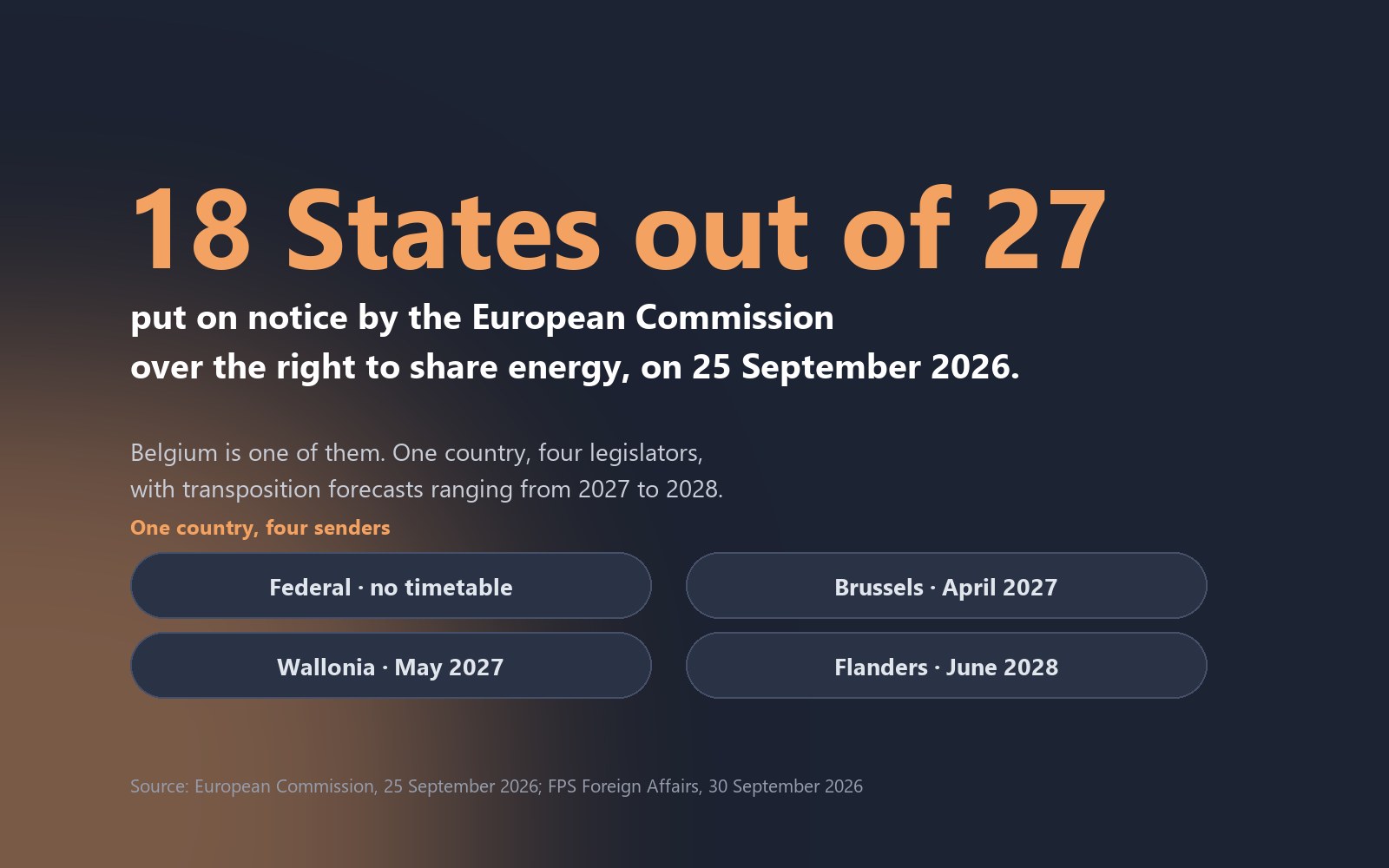
On 25 September 2026, Belgium's letterbox had a busy day. Three letters from the European Commission, all of them letters of formal notice: one on electricity, one on hydrogen and gas, one on money laundering. The one that concerns your solar panels, your apartment building and your bill is the first.
In 30 seconds
- 18 Member States out of 27, Belgium included, have not notified the full transposition of the European rules on free choice of supplier and the right to share energy (Directive 2024/1711). Deadline: 17 July 2026.
- Belgium has two months to reply, so by late November. No automatic fine, no new rule tomorrow morning.
- Why the delay? One country, four legislators (federal, Brussels, Wallonia, Flanders), with forecasts ranging from April 2027 to June 2028.
- Energy sharing within a building is possible today. Waiting for "the new law" only postpones your savings.
The letter of 25 September
Here are the 18 recipients of the "energy sharing" letter:
- Belgium
- Estonia
- Ireland
- Greece
- Spain
- France
- Croatia
- Latvia
- Lithuania
- Luxembourg
- Hungary
- Malta
- Netherlands
- Poland
- Romania
- Slovenia
- Finland
- Sweden
And those who received nothing:
- Bulgaria
- Czechia
- Denmark
- Germany
- Italy
- Cyprus
- Austria
- Portugal
- Slovakia
Two thirds of the Union, then. But be careful not to read the list backwards: the Commission's press release does not say the other nine are beyond reproach. It only says that these 18 latecomers have not notified a complete transposition. Nor does it publish the letter sent to Belgium, or the list of missing articles. We know that something is missing, but not what.
And Belgium did not receive just one letter that day. It is also among the 26 Member States put on notice over the hydrogen and decarbonised gas directive (only Italy was on time, deadline 5 August 2026), and among the 18 Member States targeted over certain measures of the 6th anti-money-laundering directive. Only the fourth envelope of the day, on cobalt in toys, passed Belgium by.
Nor was it the first letter about this text. In March 2025, the Commission had already written to 26 Member States, Belgium included, about other provisions of the same Directive 2024/1711, due by 17 January 2025. Only Denmark had then declared a complete transposition on time. The energy-sharing provisions enjoyed a longer deadline, until 17 July 2026: that is the deadline that has just been missed.
What the directive actually requires
A directive sets a result to be achieved, and each Member State chooses the means. The directive that has not been transposed acts on two points:
- Article 4 (amended): free choice of supplier and the possibility to switch more easily;
- Article 15a (new): households, SMEs and public bodies may share the renewable electricity they have produced or stored with other customers. The shared electricity is deducted from each participant's metered consumption when the supplier calculates the energy component of the bill, and participants may entrust the organisation to a third party.
"But Belgium already allows sharing!" True: sharing has existed here for a few years in various forms. But transposition is not judged on general impressions. In a judgment of August 2025 concerning another directive, Belgium argued that its regulations already complied on many points. The Court of Justice dismissed the argument and recalled that a positive act of transposition is required, which must then be notified. Having the right recipe is not enough, the paperwork has to be handed in.
One country, four senders
Why is Belgium regularly on this kind of list? The FPS Foreign Affairs, which coordinates the matter, says so itself on its website: given the nature of the legal instruments and the country's institutional structure, transposition "is a complex process". Each level of government is responsible for the transpositions that fall within its powers. For energy, that means four pieces of homework to hand in.
| Entity | Where do things stand? | Forecast for full transposition |
|---|---|---|
| Federal | Preliminary draft law approved by the Council of Ministers on 18 July 2026, the day after the deadline, and sent out for opinion. | No timetable |
| Brussels | Preliminary draft ordinance adopted at first reading on 25 June 2026, submitted to Brugel for opinion (opinion no. 420). | April 2027 |
| Wallonia | Update of the decree under consideration, with a peer review organised within Interreg Europe. | May 2027 |
| Flanders | Decree of 3 July 2026 (published 3 August): partial transposition of the directive, with energy sharing possible whatever the type of supply contract. Two articles only enter into force on 1 November 2027. | June 2028 |
Administrative forecasts of the FPS Foreign Affairs as of 30 September 2026, relayed by BeProsumer. These are not deadlines granted by Europe.
One remark in fairness: Brussels has not been idle, its preliminary draft predates the deadline. But a preliminary draft is not yet an ordinance.
The context does not help. According to Commission figures quoted by The Brussels Times in summer 2025, Belgium had 73 infringement procedures under way, placing it sixth in the Union (tied with Hungary), and fourth for late transposition. The FPS Foreign Affairs, for its part, insisted that the Belgian authorities certainly have no bad intentions, but that things sometimes go off the rails.
What follows the letter: what if nobody replies?
A letter of formal notice is neither a fine nor a judgment. It is the first letter in a correspondence that can be long:
- The letter of formal notice (25 September 2026)The Commission asks Belgium to reply, complete the transposition and notify its measures within two months. This is where we are.
- The reasoned opinionIf the reply is unconvincing, the Commission spells out its complaints and sets a new deadline, usually two months.
- Referral to the Court of JusticeLast resort, with no announced date. Nothing is automatic.
- The financial penaltyFor failure to notify transposition measures, Article 260(3) of the Treaty allows a lump sum and/or a penalty payment to be requested from the first referral to the Court.
Theoretical? Not quite. Belgium has already been penalised on this basis:
The 2025 case also shows the real tempo. Letter of formal notice in September 2022, reasoned opinion in April 2023, action before the Court in January 2024, transposition completed in April 2024, judgment in August 2025. Almost three years between the first letter and the ruling, and an amount calculated even though Belgium had eventually complied. The failure had lasted more than a year and a half after the deadline.
A closer look at the 2025 case: when a single floor lags behind
This case speaks to a country with several floors, so let us look at it more closely. It concerned the directive on work-life balance for parents and carers (paternity leave, parental leave, carers' leave, flexible working arrangements), to be transposed by 2 August 2022. On that date, several Belgian entities had not finished transposing: the federal State, the Walloon Region, the French Community and the German-speaking Community.
During the proceedings before the Court, Belgium eventually complied: the failure ended on 23 April 2024. It then argued that only three of the provisions at issue were essential, that its regulations already complied on many points and that the consequences were very limited, since only three categories of statutory staff in the Flemish Region remained concerned. The Court saw no mitigating circumstance: transposing is an essential obligation, and gaps in only part of the territory remain a failure by the State. It also noted that Belgium had not shown "exemplary diligence", since it took about 21 months after the directive's deadline, including 10 months after the end of the reasoned opinion's deadline. Finally, it judged the failure to be of some gravity, since the directive aims at equality between women and men. Result: €2,352,000.
The lesson applies to energy sharing: in a country with several floors, it only takes one floor lagging behind for the Belgian State as a whole to be condemned. The FPS Foreign Affairs has in fact presented these two 2025 rulings as a wake-up call for all Belgian authorities.
Worth keeping in mind
- Rulings are rare: the Commission generally prefers to find a solution with the Member State concerned.
- No penalty has been announced in the "energy sharing" case, and participants will draw no compensation from it.
- But the pressure is real, and Belgium now knows what a delay costs.
The twist: having a rule is not the same as being in order
The most curious thing about the list of 18 is who is on it. Spain and France are there, even though they already had collective self-consumption schemes: Spain raised the maximum distance to 5 km in March 2026, France revised its energy allocation rules in June. Conversely Germany, which launched energy sharing on 1 June 2026 (section 42c of its energy act, despite criticism from energy communities that find the rules timid), received no letter.
The moral: the Commission's letter measures one precise thing, the notification of a complete transposition. It says nothing about the quality of the scheme on the ground. And that is where it gets interesting for us.
On the ground: practice survives despite the legal obstacles
While the texts are being negotiated, projects are getting off the ground. Here is some recent news, from businesses and from public authorities.
The Perlonjour solar island: inaugurated on the very day of the letters
On 25 September 2026, while the Commission was posting its registered letters, the Perlonjour solar island was inaugurated in Soignies: 9,494 photovoltaic panels floating on the water of a former quarry, for 6.1 MWp of capacity and an estimated average annual output of 5,695 MWh, the consumption of about 1,630 households. The panels have been producing since May 2026. The project grew out of a public tender launched by the City of Soignies, which appointed the citizens' cooperative CLEF and its partners. More than 400 people invested through the cooperative, which raised more than €700,000 (target: €450,000) to finance the solar island among other things, and the City became a shareholder of the operating company.
For us, this project is a textbook case. A power purchase agreement (PPA) now covers 65% of the electricity used at the Tellier des Prés site of Heidelberg Materials. But an installation of this size does not produce to the rhythm of a single consumer: at weekends, early in the morning, during production slowdowns, part of the energy goes to the grid. That is where our work begins. Heidelberg Materials is the first large industrial player to have connected its Walloon sites and its partners within its own sharing operation, which we manage with it: the surplus is shared there with other neighbouring companies, at a rate agreed between the members rather than set by the market.
A PPA and an energy community are not competing options. The first secures the bulk of supply over the long term, the second places what the site cannot absorb at the time. Together they push the local use of the same installation far higher than either would alone, and they relieve a grid that badly needs it. And all of this works under today's rules.
Inter-municipal companies and public authorities: tenders follow one another
On the public side, nobody is content to watch the post go by any more:
- Hainaut, through NEOVIA. The company backed by CENEO and the inter-municipal companies IDEA, IDETA and IGRETEC has already fitted 139 public buildings with solar panels. A new tender was launched at the end of 2025 to equip buildings and a car park of two inter-municipal companies and a CPAS (nearly 3 MWp, works from 2026), and a second phase for municipalities is announced for 2026. The stated aim: on-site or collective self-consumption, through renewable energy communities.
- Picardy Wallonia, with WAPIGREEN. Announced in 2024, this project initiated by IDETA, IPALLE and IEG aims at an energy community of 35 sites (businesses, hospitals, public bodies) sharing about 40 GWh a year, with a roll-out spread until November 2027.
- Belgian Luxembourg, with IDELUX. The inter-municipal company's 2026-2028 strategic plan lists energy sharing through energy communities among its objectives, with a five-step support path for project holders.
- Inter-municipal companies recognised as "local authorities". A Walloon Government decree of 5 February 2026 extends this notion to inter-regional inter-municipal companies, to inter-municipal companies made up solely of German-speaking municipalities and to legal entities controlled by the entities concerned.
- Municipalities. In Chimay, the municipal council approved on 26 August 2026 a set of specifications to create a renewable energy community between the City, the CPAS, the water authority, the sports inter-municipal company and the tourist office. The aim: to cut electricity purchases by up to 50%, for hoped-for savings of €125,000 to €150,000 a year.
- Brussels. Brussels Environment published on 4 September 2026 a tender to appoint a facilitator for "Energy sharing and energy communities", with a lot dedicated to collective support for apartment buildings (bids due by 9 October). As of 3 September, the free facilitation service was suspended.
One brake remains, well known to lawyers: the fear of getting it wrong. In a study carried out by the Empower project among Brussels municipalities, 67% of the municipalities surveyed were not engaging in sharing, mainly for fear of breaching public procurement rules. Yet for a purchase estimated at less than €30,000, the "low-value contract" allows a simplified procedure: it is recommended to consult at least three players, and a simple e-mail may suffice to request offers.
What still stalls, especially in Wallonia
Not everything runs smoothly, however. The BeProsumer association, part of whose analysis we draw on, has documented since April 2026 what stalls in Wallonia:
- the activation of the R3 metering regime (the quarter-hourly readings needed for sharing), which can take months and block a whole group as long as one participant is not ready;
- missing or erroneous data, which complicate the calculation of volumes and billing;
- additional supplier fees that can absorb the savings;
- at least three active communities whose viability is compromised, one of them even considering closing.
A peer review conducted within Interreg Europe reaches a similar finding: administrative complexity, little automation of data exchanges and additional costs.
The link with the letter of formal notice? The guarantees of Article 15a (non-discriminatory access, model contracts, protection against unfair treatment, at least monthly data, contact point) bear precisely on these points.
So what does it change, in practice?
Today: nothing
No tariff, no rule, no right changes for apartment buildings, associations, inter-municipal companies, municipalities, industrial players, SMEs or panel owners. Sharing within a building remains possible under current conditions. Grid fees, green certificates and the incompatibility between sharing and net metering remain in force.
Tomorrow, perhaps: more guarantees
Once the regional and federal texts are adopted (2027 for Brussels and Wallonia, 2028 for Flanders according to the forecasts), one can expect wider access for social tariff beneficiaries and for businesses, as well as a clearer framework for projects by municipalities and CPAS.
What Europe is preparing elsewhere
In the same direction, the Commission published in March 2026 its "citizen energy" package (COM(2026) 115) and Recommendation (EU) 2026/1007 of 30 April 2026: sharing across the whole bidding zone, no-upfront-cost formulas for tenants, clearer definitions. The course is set: more sharing, and simpler.
The trap: waiting for the last episode
A perfectly legitimate reaction would be: "I'll wait until the law is passed". Let us do the maths: between a preliminary draft of summer 2026 and an effective transposition, we are talking 2027, even 2028. Meanwhile the panels produce, the neighbours consume, and nobody shares.
Above all, the letter of formal notice confirms one thing: the right to share is becoming a European obligation, so the market is here to stay. That is a reason to prepare, not to postpone.
At RaYSun, we do not look at who wrote to whom. We look at four things, because they are what counts on a bill:
- Activation: on what date does sharing really start?
- Data: is it there, complete, correct?
- Billing: is it accurate, readable, regular?
- The gain after fees: how much is left once everything is paid?
A building, a co-owned property, a site to make the most of?
Energy sharing is possible right now. Let's see together what it would yield for you, with figures to back it up.
Request a simulationSources
- European Commission, press release of 25 September 2026: DG Energy version · French version (PDF)
- European Commission, representation in Malta, infringements package of 27 March 2025
- European Commission, Implementing EU law
- pv magazine France, 29 September 2026
- Renouvelle (Energie Commune), 8 October 2026
- BeProsumer, 13 October 2026
- La DH, Perlonjour solar island: 24 September 2026 · 28 September 2026 · 21 August 2023
- RaYSun, LinkedIn post of 25 September 2026 and WalloWatt page of sharing operations
- CENEO, 2025 management report and 2026-2028 strategic plan
- IEG, WAPIGREEN project, 17 April 2024 · IDELUX, 2026-2028 strategic plan
- UVCW, extension of the notion of "local authority", 27 February 2026
- L'Avenir, Chimay considers creating a renewable energy community, 27 August 2026
- Brussels Environment, Energy sharing and energy communities facilitator · contract notice of 4 September 2026
- Renouvelle, Electricity sharing and public procurement: how does it work?, 13 October 2026
- Belgian Official Gazette, Flemish decree of 3 July 2026 (partial transposition of Directive 2024/1711)
- FPS Foreign Affairs, Transposition and infringements
- Brugel, opinion no. 420 on the preliminary draft transposition ordinance
- Interreg Europe, Priorities for the electricity sharing legal framework in Wallonia, October 2026
- Court of Justice, judgment C-543/17, Commission v Belgium (8 July 2019) and judgment C-68/24, Commission v Belgium (1 August 2025)
- The Brussels Times, Belgium fined over €4 million for late transposition of EU directives, 14 August 2025
This article is a plain-language explainer and does not constitute legal advice. National timetables are estimates that may change. The infringement figures quoted date from summer 2025.