On 11 February 2026 the European Court of Auditors published its special report 10/2026 on energy communities. The subtitle is already an admission: "Untapped potential".
The figure that sums it all up: in its 2022 solar energy strategy, the EU had committed that every municipality with more than 10,000 inhabitants would have at least one renewable energy community by the end of 2025. At the start of 2025, it stood at 27.3%. The Court concludes that the target has most probably not been met.
And Belgium? 11.9% of municipalities with more than 10,000 inhabitants. Far behind the Netherlands (81%), Denmark (86.2%) or Germany (63%). Nine Belgian municipalities out of ten still have no energy community on their territory.
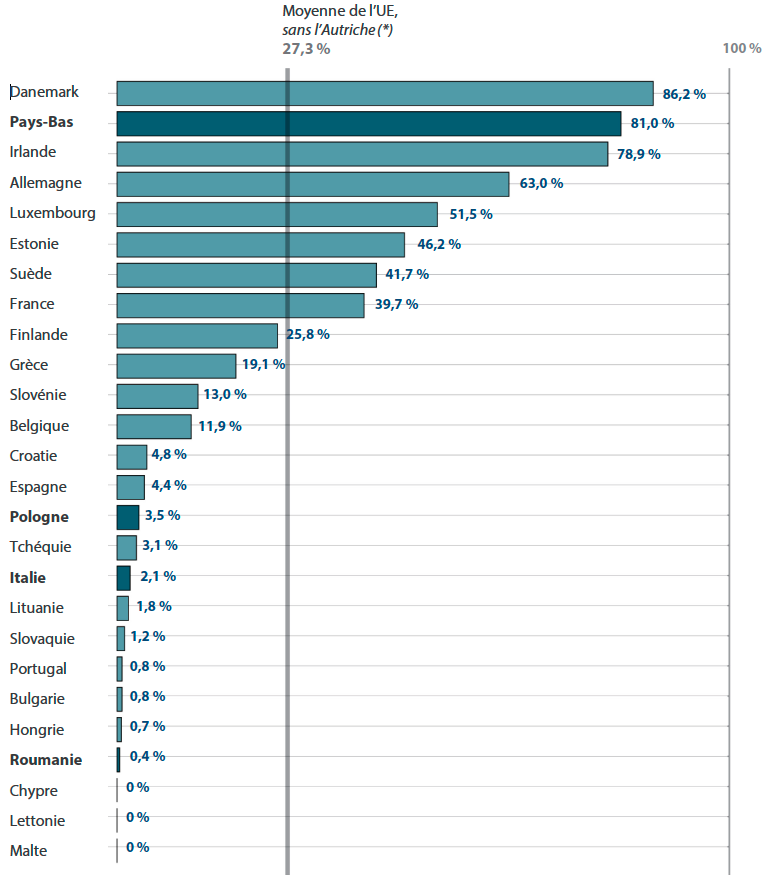
Source: European Court of Auditors, special report 10/2026, figure 7.
What interests us here is not the ranking. It is the list of reasons. We come across them every week in the field, and our model was built around them.
First, a footnote worth the detour
Below the ranking chart, an asterisk. The European average of 27.3% is calculated "excluding Austria", because the TANDEM database used by the auditors contained no location data for Austrian energy communities. Without geolocation, a community cannot be linked to its municipality, so no coverage rate can be calculated. Austria was simply removed from the calculation.
Yet Austria is probably the most advanced country in Europe on the subject. The EAG monitoring report published in 2025 by the Austrian regulator E-Control counts 3,868 renewable energy communities in mid-2025, compared with 364 two years earlier. For a country of around 2,100 municipalities. Lower Austria alone has 958.
What triggered this was the 2021 Erneuerbare-Ausbau-Gesetz: a clear legal framework from the start, and above all a reduction in grid tariffs on locally shared energy. The framework keeps evolving, with the new Elektrizitätswirtschaftsgesetz that entered into force at the end of December 2025, whose provisions on energy communities apply from 1 October 2026.
So: the country with the highest density of energy communities in the Union is exactly the one the Court could not measure, for lack of a usable register. It is the perfect illustration of its recommendation no. 3, which asks the Commission to publish better guidance on the registration and monitoring of communities. And it puts the 27% into perspective both ways: the average excludes the best pupil, but the best pupil is invisible in European statistics.
What the Court identifies as obstacles
Four things come up again and again, and they hang together.
Nobody understands the definitions. Two partially overlapping European definitions: the renewable energy community on one side, the citizen energy community on the other. Two of the four Member States audited use national concepts that do not match the European framework. And in the focus groups organised by the Court, half of the participants consider their own country's definitions insufficiently clear. In Poland, it is 100%.
You need an expert to find your way. Guidance exists, but in Poland, Italy and Romania it is fragmented or hard to use without outside help. The Italian case is the most telling: the communities surveyed find the documentation detailed and well structured, and still say they have to go through professionals to interpret it correctly.
Yet another legal structure has to be created. Box 2 of the report, on apartment buildings, is enlightening. An association of co-owners cannot be registered as such as an energy community, because membership of a co-ownership is compulsory whereas membership of a community must remain voluntary and open. A separate legal entity therefore has to be set up, alongside the one that already manages the building. The Court writes in black and white that this obligation is an obstacle, and asks the Commission to clarify the options by the end of December 2026.
Grid connection drags on. The communities surveyed report an average wait of 21 months for a grid connection. In the Netherlands, the average rises to 36 months and one recorded case reaches 132 months. In 2024, more than 4 GW of renewable capacity was waiting for a connection there, enough to supply three million people.
Add it up: a vague framework, an expert to pay, a non-profit or a cooperative to create, two years of waiting before producing. That is the real cost of entry. And that is why we are at 27% (excluding Austria).
What we do at RaYSun
We do not ask anyone to create a community. They already exist.
CityWatt in Brussels, WalloWatt in Wallonia, SamenWatt in Flanders. These are operational structures, with producers under contract and energy available today. Joining one of them means signing, not founding.
In practice, for a consumer:
- No investment. No panels to install, no meter to change, no works.
- The existing supply contract stays intact. We step in as a second supplier on the same connection point. When the community cannot deliver, the incumbent supplier automatically takes over.
- The community tariff is fixed by contract, for up to ten years, and it is lower than the current contract. It is not a product indexed on the market.
- No waiting for a connection, since we use the grid and the meter that are already there.
And if you produce, which is the case for many businesses that put panels on their roof without knowing what to do with the surplus:
- Your installation does not move. It stays connected as it is today, at the same point, with the same meter.
- The surplus you inject today at a knock-down price goes to identified consumers, at a contractual tariff higher than what classic injection pays you. As an order of magnitude: an injection valued at 30 to 45 €/MWh with a supplier rises to around 60 €/MWh in a community, while the consumer on the other side drops from 200-150 to 100-80 €/MWh. The gap between the two does not disappear, it narrows, and both come out ahead.
- You remain free for the rest. What you self-consume stays self-consumed; what the community does not take keeps leaving as before.
The Court's report mainly treats communities as carriers of new production projects, with the connection delays that implies. That is one reading. The other is that there are already, on Belgian roofs, installed megawatts whose surplus leaves at the injection tariff for lack of a local taker. Those need no permit, no works and no queue. Just someone on the other side. A meeting.
That is also why we look for as many producers as consumers: the more of one, the better for the other.
On payback, the Court recalls that the European solar energy strategy aims at periods under ten years, and notes that the Dutch projects analysed range from six to twelve years depending on the year. In our model, the question does not arise in those terms. The consumer invests nothing, so has nothing to pay back. The producer has already invested: the community shortens their payback. Win-win-win.
The point in the report nobody talks about, and which matters most
In paragraph 74, the Court writes something few people pick up. For communities to genuinely relieve the grid, the energy produced must be consumed locally in real time, to the second. And it adds that this is usually not the case, because solar produces at midday whereas consumption peaks in the early morning and early evening.
That is exactly the problem we spend our days solving.
We do not just put producers and consumers in the same box. We simulate, on each candidate's real consumption profile, the volume we can actually allocate to them. That is why we look first for entities (public, private, mixed) that consume during the day or at weekends, rather than at night. A good community member is not just a big consumer or a big producer: it is a consumer whose curve looks like the production curve.
The same logic applies to flexibility and storage, the subject of recommendation no. 6 of the report. Dutch and Polish grid operators told the auditors they would connect renewable projects faster when they come with demand management, load shifting or storage, because it reduces congestion. A well-built community is a virtual battery: what is produced here is consumed here.
Where we refuse to pretend
The report contains a criticism we take seriously. The Court, like the European Economic and Social Committee, warns of the risk of businesses or municipalities setting up communities for the sole purpose of capturing benefits, without real local participation. The Polish figure is brutal: in a random sample of twenty cooperatives, only two had citizens among their members, and the registered cooperatives have on average three or four members each.
Our core business is B2B, and we own it. But a community that only circulates value between institutional players misses its purpose. That is why sharing must go hand in hand with a clear mission of education, awareness and advocacy for a just transition. At RaYSun we play our part by organising or joining discussions on these issues, where everyone is welcome and has their place. In the coming weeks alone:
- we will be in Namur presenting our tool for industrial players;
- we will be in Uccle at Quartier Libre (a cooperative), to hear the testimony of committed citizens;
- we will be in Brussels, talking with policymakers and the Brussels regulator;
- and before the end of the year we will go to Flanders to talk with those who want to share.
A final word on a debate the report opens and which, in Belgium, is already settled. The Court worries that, as self-consumption and sharing develop, a growing share of grid costs is borne by consumers who have no access to them, generally the least well-off households, and notes that none of the four countries audited has formally assessed this effect. In Belgium, except in Brussels, grid costs and levies are regulated and apply to everyone, energy communities included. Our saving therefore does not come from an exemption. It comes from the gap between what a producer receives for their injection and what a consumer pays for the same electricity, a gap we narrow to the benefit of both.
To conclude
The Court recommends that the Commission clarify the rules by the end of 2026 and finally define measurable targets by the end of 2027. Fine. But a Belgian consumer does not have to wait until 2027 to pay less for electricity.
Come and grow these numbers:
- 3 sharing operations in Flanders;
- 10 operations in Wallonia;
- 2 in Brussels.
In total, at RaYSun, that is 15 sharing operations and 16.5 GWh exchanged per year across the three Regions. The mechanics already work.
If your non-profit, your citizens' group, your business or your municipality consumes more than 50 MWh a year, and mostly during the day, a simulation on your real profile takes a few minutes.
And if you have panels whose surplus currently leaves at the injection tariff, tell us. That is exactly what we are looking to place.
Sources
- European Court of Auditors, special report 10/2026, "Energy communities – Untapped potential", adopted on 11 February 2026, available on eca.europa.eu. References used above: target achievement rate and ranking by country (paragraphs 06, 10, 39-40 and figure 7); exclusion of Austria (note to figure 7); definitions and perceived clarity (paragraphs 17-23 and figure 4); guidance hard to use without an expert (paragraphs 50-57); apartment buildings (box 2 and recommendation no. 1); connection delays (paragraphs 67-72 and figure 11); real-time consumption and flexibility (paragraphs 74-76 and recommendation no. 6); payback periods (paragraphs 77-86 and figure 13); citizen participation (paragraphs 58-66); effect of levy reductions on other consumers (paragraphs 84-85).
- European target: European Commission, EU solar energy strategy, COM(2022) 221.
- Legal framework for energy communities: Directive (EU) 2018/2001 (RED II) and Directive (EU) 2019/944 (internal electricity market).
- Austrian figures: E-Control, EAG monitoring report 2025 (3,868 renewable energy communities in mid-2025, compared with 364 in mid-2023; breakdown by Land). See the summary published by Wiener Stadtwerke and the E-Control portal.
- Austrian framework: Erneuerbare-Ausbau-Gesetz (EAG, 2021); Elektrizitätswirtschaftsgesetz (ElWG), in force since 24 December 2025, provisions on energy sharing and energy communities applicable from 1 October 2026, with transfer of existing structures without re-founding. See the official portal energiegemeinschaften.gv.at and the legal analysis by CMS Austria.
- RaYSun figures: internal data, September 2026.